

How Long Do Dried Herbs Last?
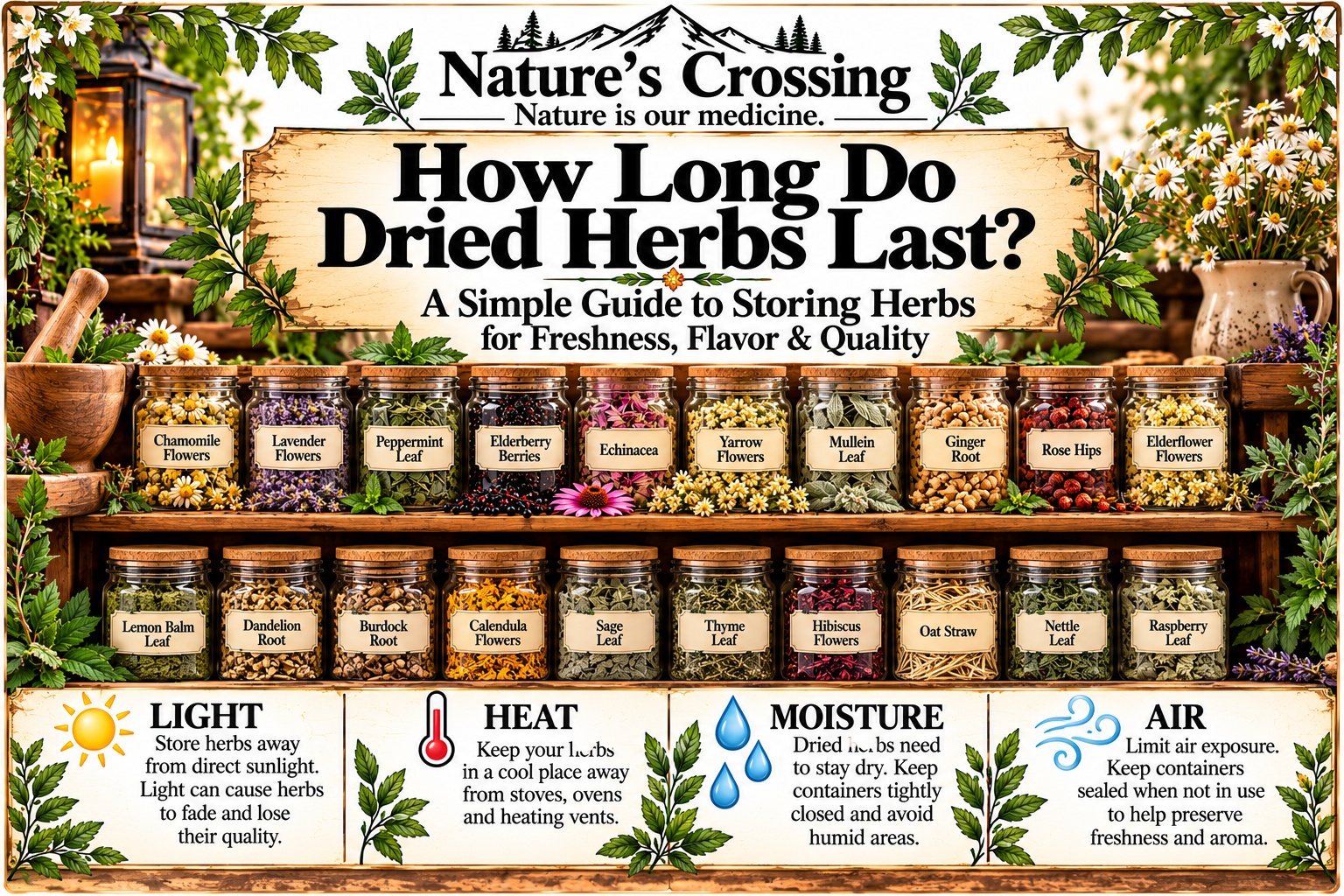
A Simple Guide to Storing Herbs for Freshness, Flavor & Quality
You found an old jar of peppermint hiding in the back of your herbal cabinet.
It still looks like peppermint.
But is it still good?
This is a question almost every herb lover eventually asks.
Dried herbs don't suddenly become useless the moment they reach a certain age. Instead, they gradually lose the qualities that made us want to use them in the first place—their aroma, flavor, color, and potency.
Learning how to store your herbs properly can help preserve those qualities for as long as possible.
Your Senses Are Wonderful Tools
One of the easiest ways to evaluate an older dried herb is to use your senses.
Look at it.
Does the herb still have recognizable color, or has it faded considerably?
Smell it.
Crush a little between your fingers. Can you still clearly smell the plant?
Examine it.
Do you see any signs of moisture, mold, insects, or contamination?
An aromatic herb such as peppermint should still smell distinctly minty when crushed.
If you're staring at the jar thinking, This doesn't smell like much of anything anymore, the herb has probably lost a significant amount of its aromatic character.
How Long Do Dried Herbs Usually Keep?
There isn't one expiration date that works for every herb.
How long an herb maintains good quality depends on the plant, which part is being stored, how it was dried, and how it has been stored.
As a practical home-herbalism guideline:
Leaves & Flowers
Often best within about 2-3 years.
Examples include peppermint, lemon balm, mullein, chamomile, elderflower, and lavender.
Roots & Bark
Often retain their qualities for approximately 2–3 years when properly dried and stored.
Examples include ginger root, burdock root, dandelion root, and cinnamon bark.
Seeds & Berries
Many can remain useful for approximately 1–3 years, depending on the plant and storage conditions.
Examples include elderberries, fennel seed, anise seed, and rose hips.
These are general quality guidelines—not guarantees or universal expiration dates.
Whole Herbs Usually Keep Better Than Powdered Herbs
There is a reason many herbalists prefer storing herbs in larger pieces and grinding them when needed.
Once an herb is powdered, much more of its surface is exposed to air.
That can mean faster deterioration of aroma and other qualities.
Compare freshly ground ginger with a jar of ginger powder that has been sitting open in a cupboard for years. The difference can be remarkable.
Whenever practical, keeping herbs whole or cut-and-sifted until you're ready to use them can help maintain quality.
The Four Things Your Herbs Don't Like
Your herbal cabinet has four major enemies:
Light
Beautiful jars of colorful herbs look wonderful displayed in a sunny kitchen window—but sunlight isn't the best friend of dried herbs.
Light can contribute to deterioration and fading.
Store herbs away from direct sunlight.
Heat
That convenient cabinet directly above the stove?
Probably not your best herbal cabinet.
Choose a cool location away from ovens, heating vents, and other heat sources.
Moisture
Dried herbs need to stay dry.
Don't dip a wet spoon into your herb container, and don't store dried herbs somewhere excessively humid.
If an herb develops mold or shows evidence that moisture has entered the container, discard it.
Air
Repeated exposure to air can gradually affect dried herbs.
Keep containers tightly closed when you're not using them.
Glass Jars Make a Wonderful Herbal Cabinet
Glass jars are one of my favorite ways to organize herbs.
They're reusable, easy to label, and let you see exactly what you have.
If you're using clear glass, simply keep the jars inside a cabinet or another area protected from direct light.
Amber glass can provide additional light protection.
Whatever container you choose, make sure it is clean, completely dry, and closes securely.
Label Everything
You may think you'll remember what's inside that jar.
Six months later, that mysterious chopped root may have you questioning everything.
Every herb should be labeled.
At minimum, consider including:
Common Name
Botanical Name
Date Purchased or Packaged
For your own preparations, you may also want to record the supplier or harvest information when available.
Dating your herbs makes rotating your collection much easier.
First In, First Out
Borrow a simple idea from professional kitchens:
Use your oldest herbs first.
When you purchase more peppermint, don't bury the older peppermint behind the new package.
Move the older herb forward.
This simple habit prevents forgotten jars from accumulating at the back of your cabinet.
Buy What You Will Actually Use
A giant bag may look like the better bargain.
But if you only use two tablespoons of an herb each year, buying a huge quantity may not really save money.
Smaller amounts that stay fresh and actually get used can be a much better investment.
As you learn herbalism, you'll quickly discover which herbs you reach for again and again.
Those are the ones worth keeping in larger quantities.
Give Your Herbal Cabinet a Seasonal Checkup
A few times each year, take everything out.
Wipe down the shelves.
Check your labels.
Look for moisture or contamination.
Smell older herbs.
Move the oldest herbs toward the front.
Make a list of what needs replenishing.
It's also a wonderful opportunity to rediscover herbs you've forgotten you had.
A Well-Loved Herbal Cabinet Doesn't Have to Be Huge
An impressive herbal cabinet isn't measured by how many jars are sitting on the shelves.
It's measured by how well you know the plants inside them.
Twenty herbs that you recognize, understand, store properly, and actually use can be far more valuable than a hundred forgotten bags tucked into a closet.
Start small.
Learn your herbs.
Take care of them.
And allow your collection to grow alongside your knowledge.
At Nature's Crossing, we believe herbalism begins with understanding and respecting the plants we bring into our homes.
Nature's Crossing
Nature is our medicine.
This article is provided for educational purposes. Storage life varies according to the herb, processing method, packaging, and storage conditions. Discard herbs showing signs of mold, moisture damage, pest contamination, unusual odors, or other deterioration.