

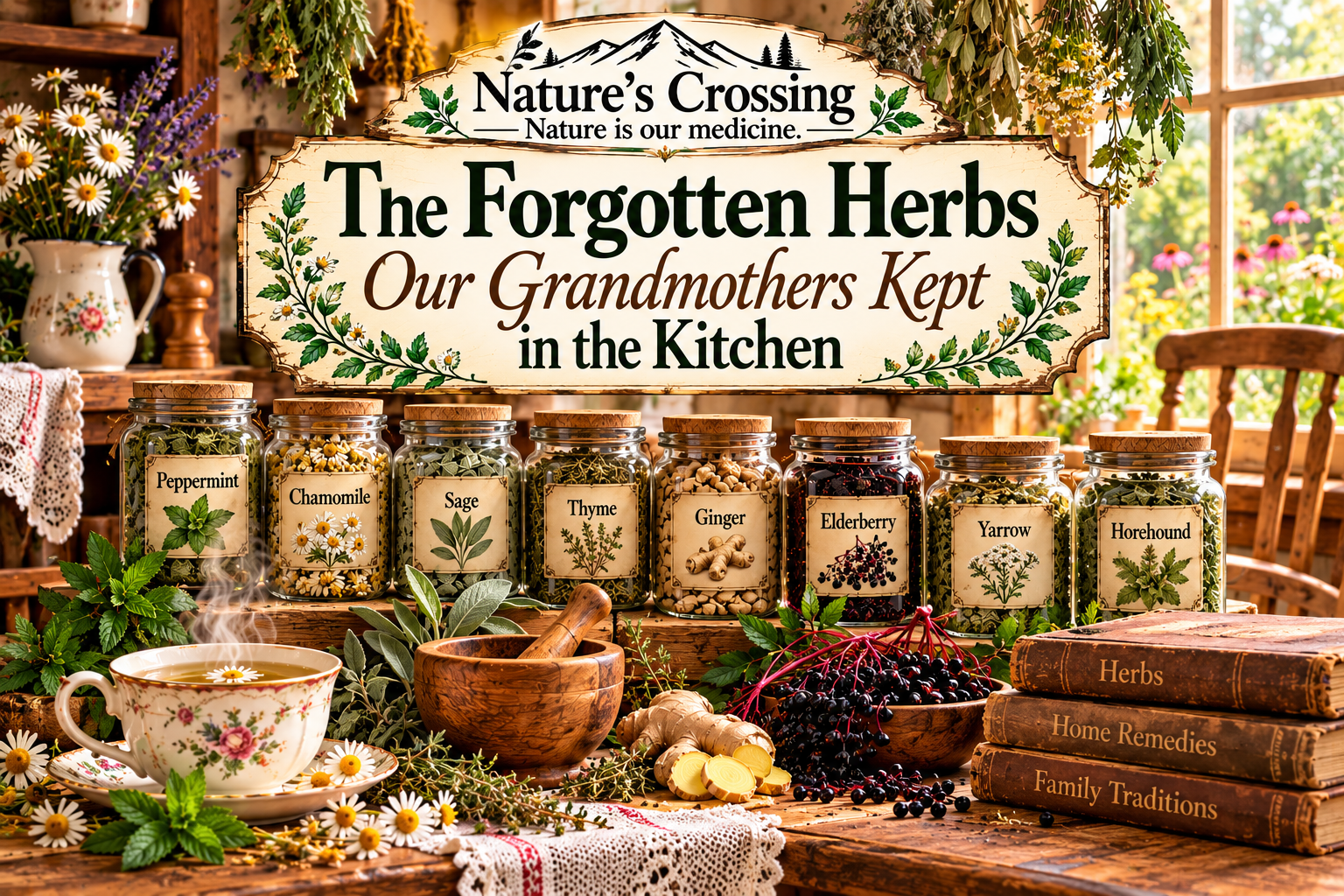
Remembering a time when the kitchen cupboard was also the family herb cabinet
There was a time when keeping herbs in the kitchen wasn't considered unusual.
They weren't always stored in beautiful matching jars, and no one necessarily called the collection an herbal apothecary. They were simply things families kept on hand.
A bundle of peppermint might be drying from the garden. Chamomile flowers could be tucked away for tea. Sage and thyme sat beside the cooking spices. Ginger waited in the pantry. Elderberries might be simmered when the seasons changed.
For many families, knowledge about these plants wasn't learned from a class or a book.
It was learned in the kitchen.
Someone showed you.
And then, someday, you showed someone else.
When the Kitchen Was the Heart of Herbal Knowledge
Long before we could search the internet for every plant we encountered, knowledge was often passed from one generation to another.
A grandmother might know which herb made a pleasant tea after supper, which plants belonged in the soup pot, or which herbs the family traditionally reached for during the colder months.
Not every tradition was scientifically understood at the time. Some practices were helpful, some were simply customary, and others have changed as we've learned more about plant chemistry, safety, and medicine.
But there was something valuable happening around those kitchen tables:
People knew the plants they used.
Let's open that old kitchen cupboard and rediscover a few of them.
Peppermint
Peppermint may be one of the easiest herbs to imagine hanging in an old-fashioned kitchen.
Its unmistakable aroma made it useful for much more than flavoring candy.
Peppermint has a long history as both a culinary and traditional herbal plant, particularly in preparations associated with digestion. A simple cup of peppermint tea also became a familiar household comfort.
Even today, peppermint is often one of the first herbs people recognize by smell alone.
Sometimes the simplest plants become the ones we remember most.
Chamomile
A cup of chamomile before bed has become almost synonymous with winding down for the evening.
And that tradition didn't begin with tea bags.
The tiny flowers have been prepared as tea for generations and have a long history of traditional use associated with relaxation and digestive comfort.
Chamomile also reminds us of something our grandparents understood quite well:
Sometimes a warm cup of tea is about more than what's inside the cup.
It's also about stopping.
Sitting down.
And allowing the day to end.
Sage
Today, many people immediately associate sage with Thanksgiving stuffing.
Our grandmothers knew it as a kitchen herb, too—but its story goes much further back.
Sage has been valued for centuries as both a culinary and traditional herbal plant. Its strong, unmistakable flavor means a little can transform soups, breads, meats, vegetables, and savory dishes.
It was the kind of plant that earned its place in the garden because it could move easily from the garden to the kitchen.
Food and herbs weren't always two separate worlds.
Often, they were the same plants.
Thyme
Another familiar resident of the spice cupboard is thyme.
We sprinkle it into soups and stews without giving it much thought, yet thyme has a long history in traditional herbal practices as well.
Its strong aroma comes from naturally occurring volatile compounds within the plant.
And that is one of the wonderful things about looking at familiar culinary herbs through an herbalist's eyes.
Suddenly that little jar labeled THYME isn't merely seasoning.
It's a plant with a history.
Ginger
Few ingredients can transform a kitchen quite like ginger.
Fresh ginger simmering on the stove produces an aroma that's warming before you've even taken the first sip.
Across many cultures, ginger has a long history as both food and traditional medicine, particularly in connection with digestion and nausea.
It can be added to meals, steeped or simmered in drinks, incorporated into honey preparations, and combined with other herbs and spices.
Grandmother may not have used the words herbal preparation.
She may simply have said:
“I'll make you some ginger.”
Elderberry
As summer faded and colder weather approached, families traditionally preserved whatever the land provided.
For some, that included elderberries.
Those dark berries have a long history in European and North American folk traditions and eventually became one of the most recognizable plants associated with seasonal herbal preparations.
Today, elderberry syrup has become extremely popular.
But the idea of preparing elderberries isn't new at all.
It's another example of an old tradition finding its way back into modern kitchens.
Elderberries require proper preparation and should not simply be eaten raw.
Yarrow
Yarrow may be less familiar in today's kitchen, but generations before us knew this remarkable little plant.
It grows in many places and has a very long history in traditional herbal practices.
Yarrow has been prepared in teas and other traditional preparations, sometimes alongside herbs such as peppermint and elderflower.
It's a wonderful example of an herb that once may have been recognized by ordinary families but is unfamiliar to many people today.
Somewhere along the way, a lot of us stopped learning the names of the plants growing around us.
Horehound
Here's one you may remember seeing in an old-fashioned candy shop.
Horehound candy.
Long before brightly colored cough drops filled store shelves, horehound was a familiar traditional herb. Its naturally bitter flavor is unmistakable, which is one reason it was often combined with sweeteners in old-fashioned preparations.
For some people, simply hearing the word horehound brings back memories of grandparents or old country stores.
And perhaps that's what makes these plants so interesting.
They're connected not only to herbal history—but to family history.
Somewhere Along the Way, We Forgot
Modern life has given us extraordinary conveniences and advances in medicine that previous generations could hardly have imagined.
But along the way, many families also lost some of their everyday knowledge about plants.
We stopped growing peppermint by the back door.
We stopped recognizing yarrow.
We bought sage in tiny containers without ever seeing the plant it came from.
Herbs became products rather than plants.
Thankfully, something interesting is happening.
People are becoming curious again.
They're growing herbs.
They're making tea.
They're asking what is inside the jars.
They're learning botanical names.
They're asking grandparents what they remember.
And they're teaching their children that the leaves, roots, berries, flowers, and seeds around us have names and histories worth knowing.
We Don't Have to Choose Between Old and New
Honoring traditional herbal knowledge doesn't mean rejecting modern medicine or believing that everything people did generations ago was correct.
We know more today.
We understand medication interactions, allergies, plant chemistry, pregnancy precautions, dosing concerns, contamination, and many other safety considerations better than previous generations often could.
We can respect traditional knowledge and use modern evidence.
In fact, responsible herbalism requires both curiosity and caution.
The goal isn't to return to the past.
It's to carry forward the parts worth remembering.
Maybe the Herbal Cabinet Never Really Disappeared
Take another look around your kitchen.
Peppermint.
Ginger.
Cinnamon.
Sage.
Thyme.
Chamomile.
You may already have the beginnings of an herbal cabinet without realizing it.
Perhaps bringing herbs back into our homes isn't really about discovering something new.
Maybe it's about remembering something we once knew.
At Nature's Crossing, that's one of the things we love most about herbalism—the opportunity to keep learning while preserving the stories and traditions surrounding the plants that generations before us knew so well.
Nature's Crossing
Nature is our medicine.
This article discusses historical and traditional uses of herbs for educational purposes only. Traditional use does not establish that an herb is safe or effective for treating a medical condition. Herbs can cause allergic reactions and interact with medications and may not be appropriate during pregnancy, breastfeeding, childhood, or with certain health conditions. Consult an appropriate healthcare professional when needed.